A site-specific ecological installation exploring soil, invisible life, biodiversity and the fragile relationships between human intervention, natural systems and material transformation.
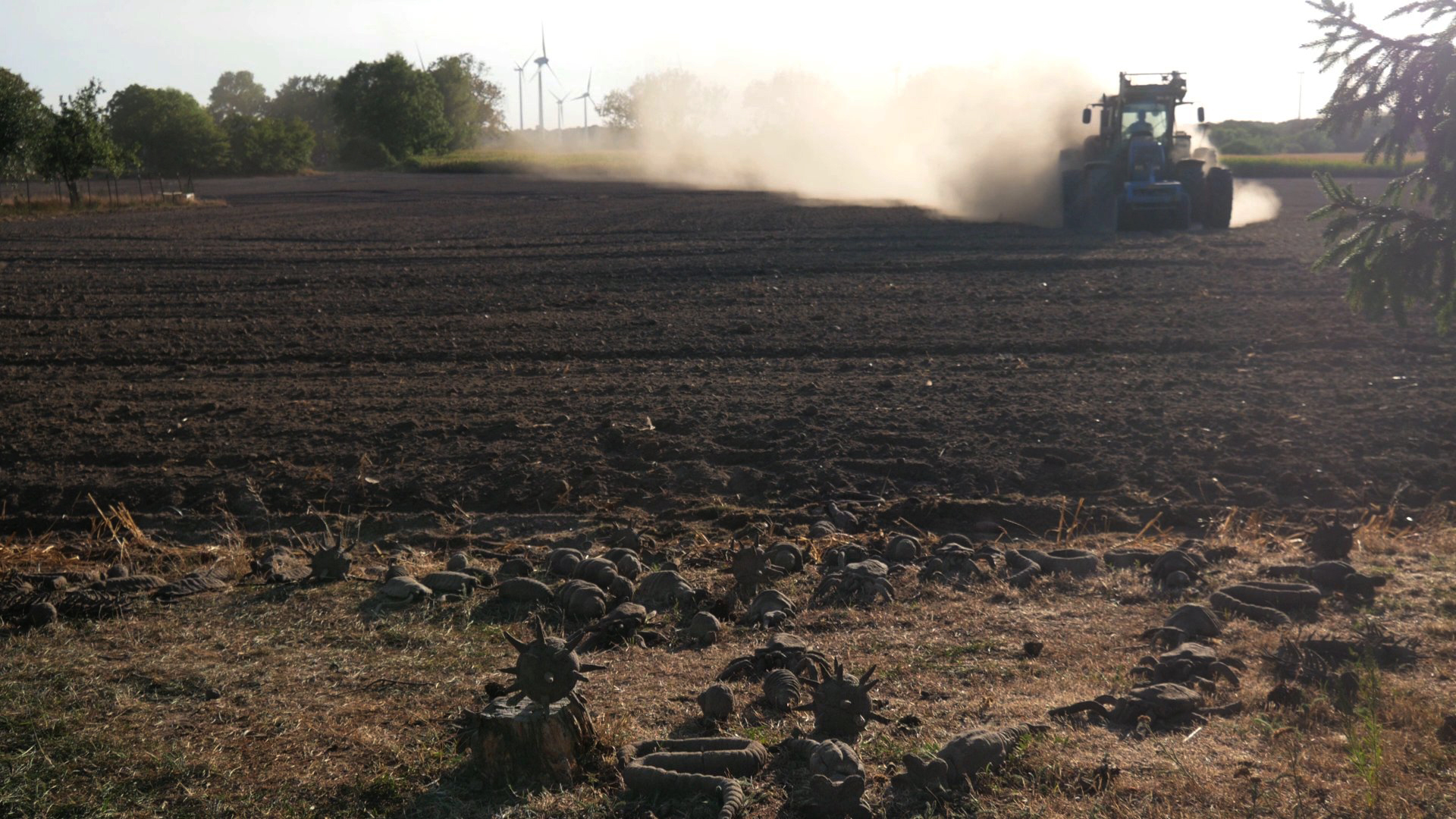
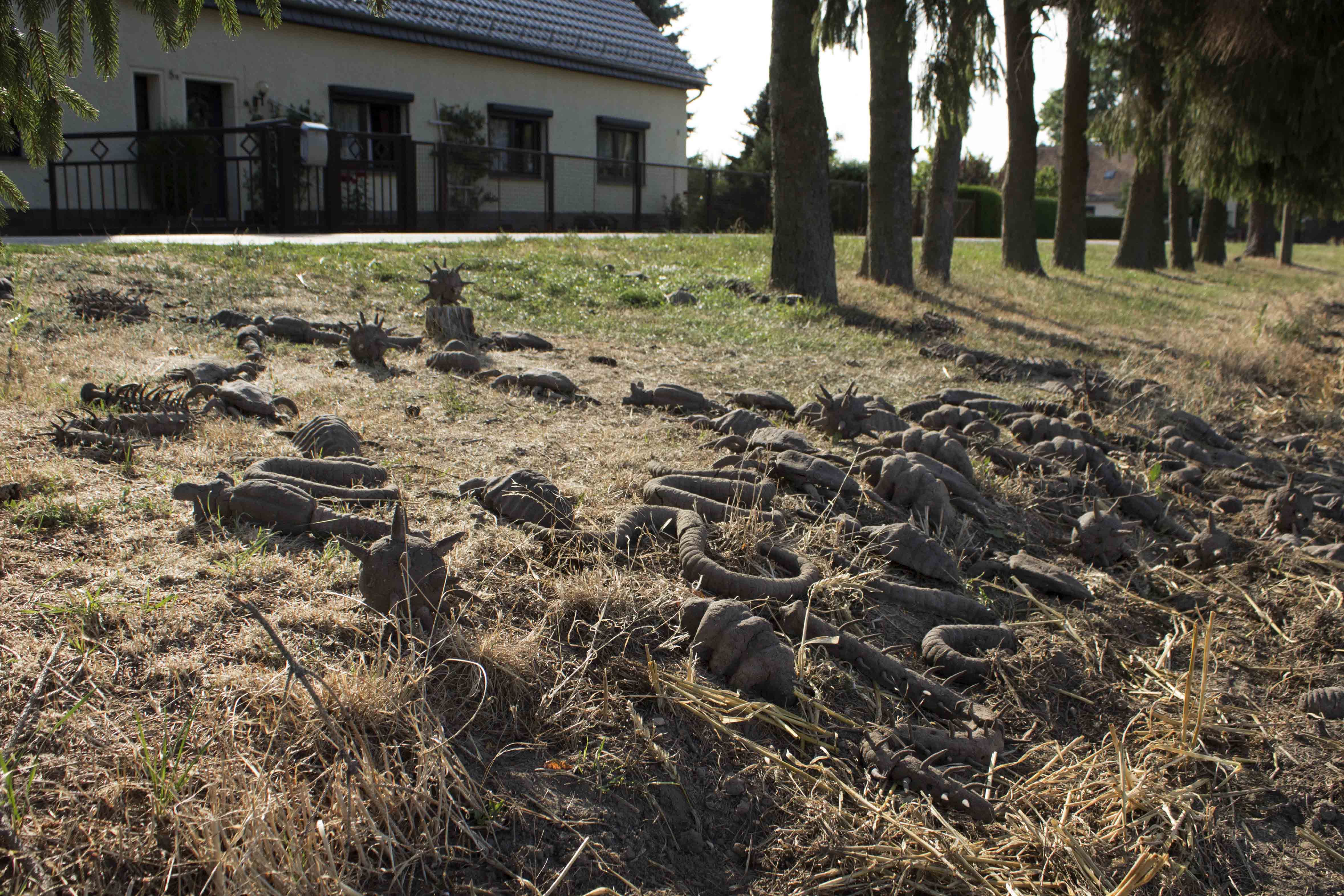
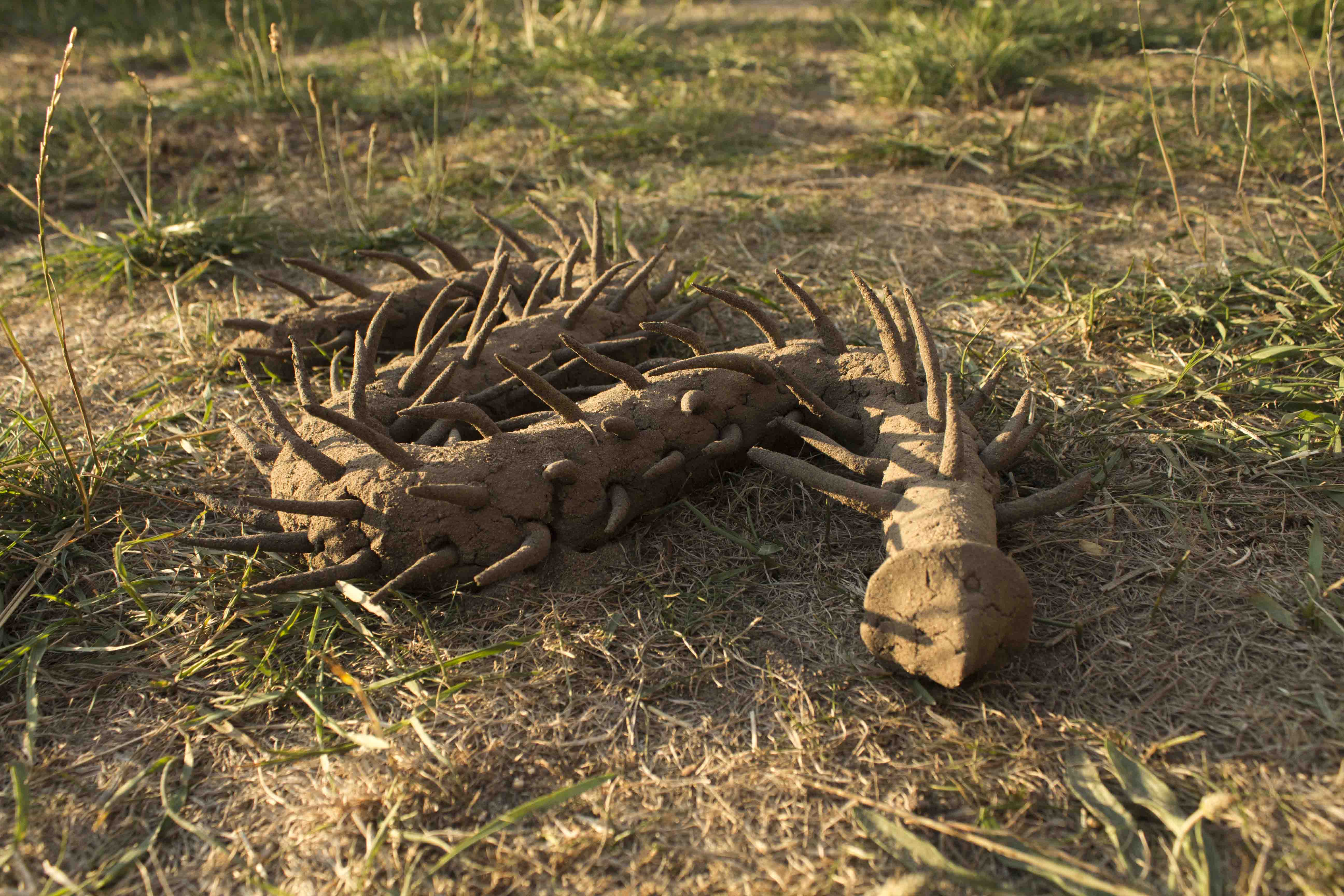
Minaminals III – The Soil We Live Of (2018) is a site-specific installation by Kirsten Wechslberger, developed during the residency Der Boden von dem wir leben at the Akademie für Suffizienz in Reckenthin, Germany. The work consists of one hundred handmade sculptures made from bioplastic and sand, installed on an agricultural field near the residency site. Their forms refer to soil organisms that usually remain invisible to the human eye, although they are essential to the fertility, stability and vitality of the soil.
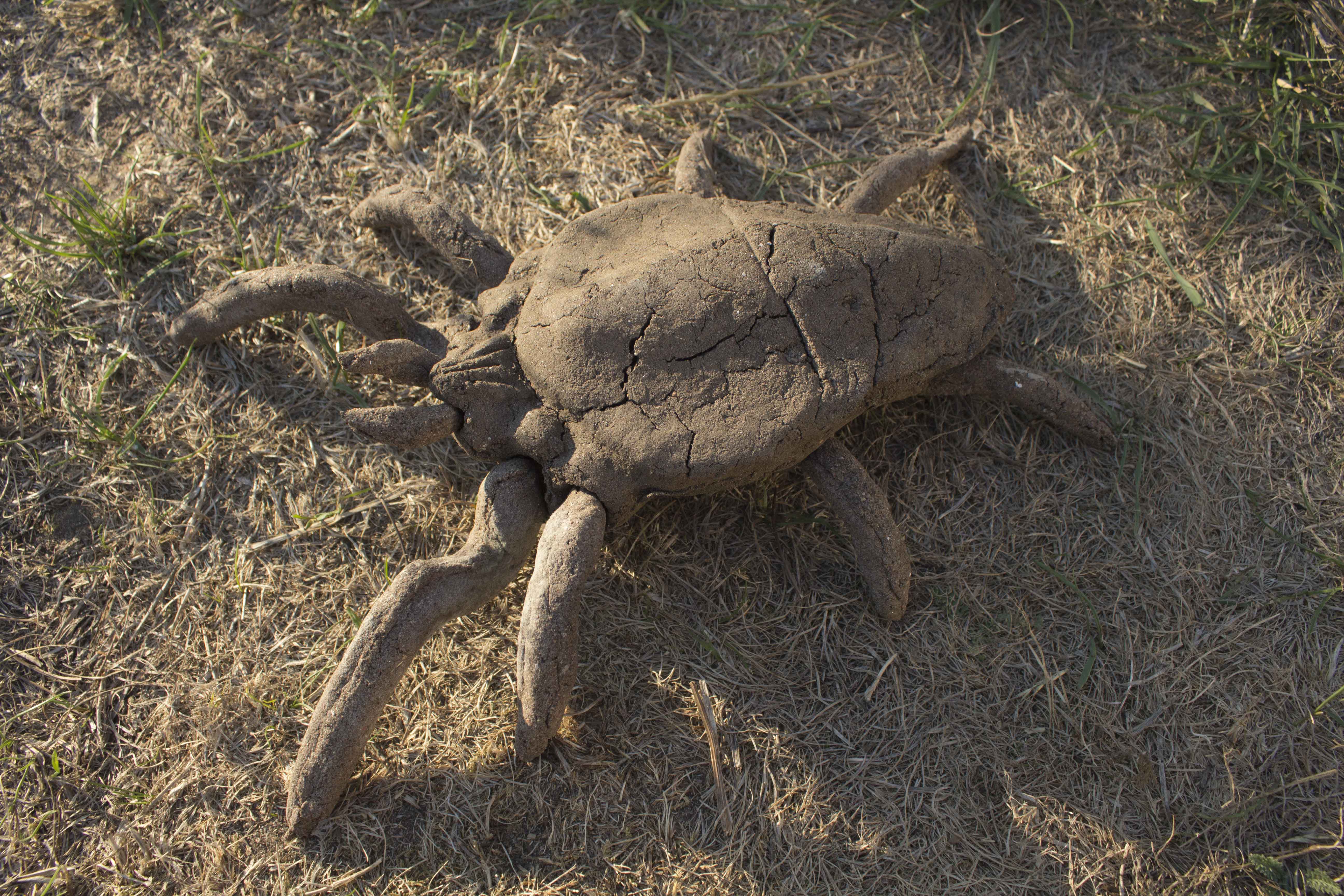
The installation brings into visibility what normally remains hidden beneath the surface. Bacteria, fungi, algae, earthworms, nematodes, mites, springtails, rotifers, bristle worms, beetle larvae, dipteran larvae, snails and antlions appear as enlarged, fragile bodies at the edge of the field. The sculptures do not function as closed natural history models. Rather, they operate as tactile translations of a concealed ecological reality. What is usually accessible only through microscopes, scientific diagrams or soil studies becomes spatial, bodily and aesthetic experience.
The central question of the work concerns how life can be perceived when it is both fundamental and largely invisible. Minaminals III translates scientific knowledge about soil ecosystems into a walkable installation. Yet the work does not merely illustrate biology. It shifts perception. It directs attention toward a world beneath human feet that is easily overlooked, compacted, sealed, exploited or destroyed. Soil appears not as a passive surface, but as a living system composed of relations, processes and dependencies.
The choice of site is crucial to the work’s meaning. The installation was deliberately placed beside an agriculturally used field. At the time of the installation, the field was a monoculture area undergoing cultivation. At the same time, the soil material used for the sculptures was collected directly on site. This created a direct relationship between material, place and subject. The figures seem to emerge from the very soil whose inner communities they make visible. They appear as emissaries from an underground world transformed, disturbed or displaced by human intervention.
This spatial decision anchors Minaminals III within a concrete ecological and social situation. Soil is not treated as an abstract motif of nature, but as a resource, habitat and object of economic use. The work was developed within a programme concerned with soil sealing, industrial agriculture, humus loss, water retention, loss of biodiversity and the consequences of human interventions into natural systems. In this context, the installation demonstrates that soil is not merely something on which humans stand, build or produce. Soil is a complex structure on which human life remains dependent.
Wechslberger’s participation in the residency was publicly announced as early as March 2018. She had been selected by the Akademie für Suffizienz, KUNST-STOFFE Berlin and Group Global 3000 for a four-week working residency in Reckenthin in the Prignitz region. This early documentation is art historically significant because it shows Minaminals III not as an isolated work that emerged suddenly, but as the result of an extended process of research and development. The announcement also confirms that bioplastic was already an established component of Wechslberger’s artistic practice before the residency began. At the time, she stated that she was looking forward to developing further bioplastic sculptures and installations.
Minaminals III therefore stands within a longer material and conceptual trajectory. The development of Wechslberger’s bioplastic material can be traced back to 2012, when she experimented with self-developed bioplastic recipes for The Road Less Travelled at the Goethe-Zentrum in Namibia. In the following years, different additives were tested until sand proved particularly suitable for creating stability, weight and an earthbound material presence. This combination of bioplastic, sand, ecological research and controlled impermanence was already central to Minaminals I and Minaminals II – Earth to Earth. Minaminals III extends this line of investigation, while shifting the focus more explicitly toward soil ecology, scientific research and the invisibility of biological life systems.
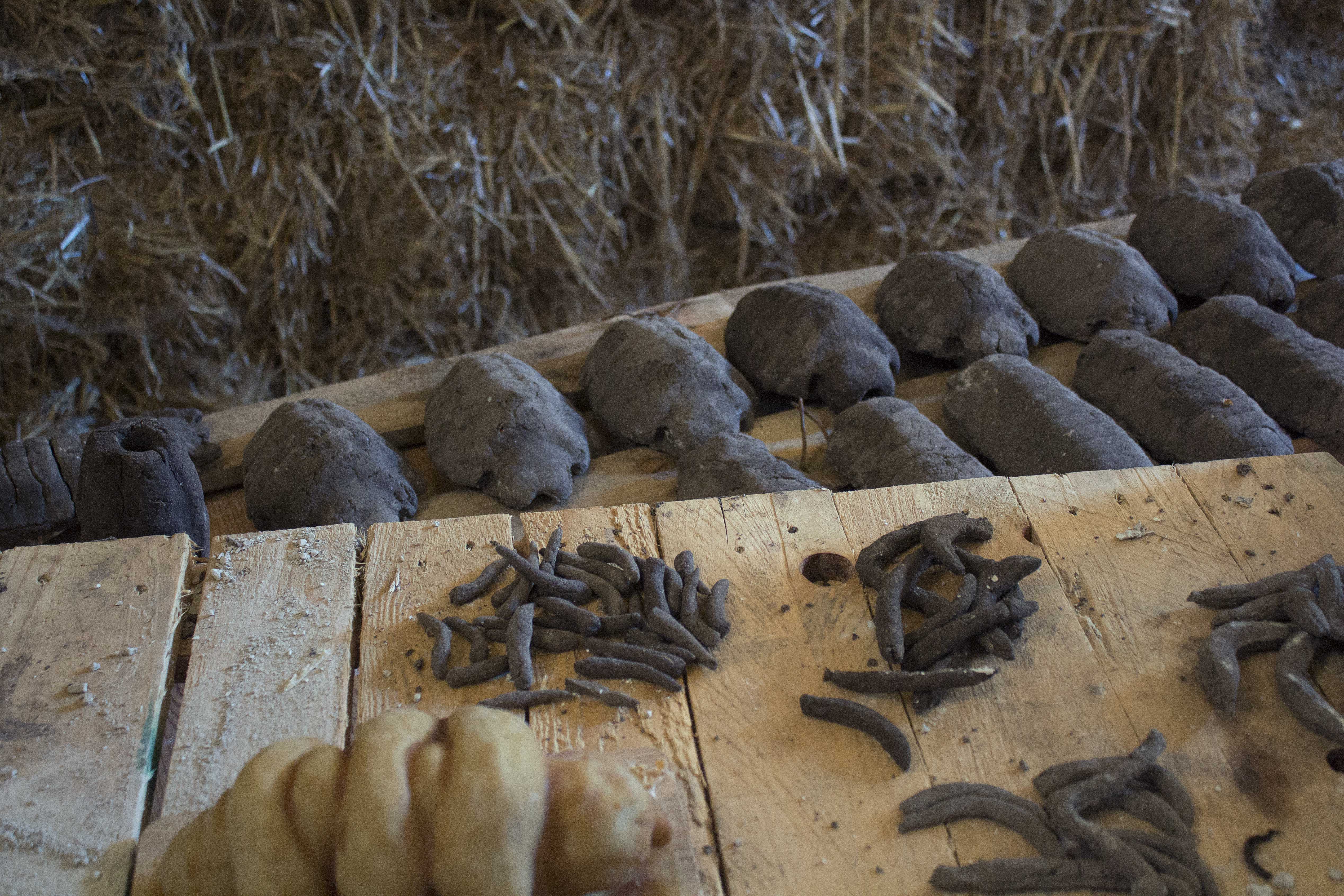
The material consists of corn starch, water, vinegar, vegetable glycerine and sand. The production methods were also chosen according to ecological principles. For the moulds, Wechslberger used natural latex and plaster instead of silicone. This process was more labour-intensive, but consistent with the conceptual aims of the work. Sustainability appears here not only as a theme, but as an artistic method. The work does not simply speak about ecological responsibility; it attempts to align its own conditions of production with that responsibility. Material, process and meaning remain inseparable.
In total, one hundred sculptures were installed for Minaminals III, while approximately one hundred and ten objects were produced. Additional pieces were made for the later presentation in Berlin, allowing visitors to touch and physically experience the material. This decision is important because it frames the work not only as a visual artwork, but also as a form of mediation. Soil and its hidden forms of life are communicated not only through images or texts, but through material contact, spatial experience and bodily proximity.
The production process included scientific research, modelling, mould-making, casting, on-site installation, photography, film documentation and, finally, the deliberate exposure of the work to natural processes of decomposition. The sculptures were not conceived as permanent objects. Their biodegradation formed part of the work. As in the earlier Minaminals projects, Minaminals III challenges the idea of sculpture as a durable, finished form. The objects exist only temporarily. They change, soften, crack, break down and gradually return to the soil.
This impermanence is not a loss, but one of the work’s central statements. Minaminals III understands sculpture as part of a cycle. The work emerges from the soil, makes hidden life visible and eventually dissolves back into the very system to which it refers. This creates a precise relationship between form and content. The work does not merely address ecological cycles; it physically participates in them. It does not remain outside nature as an observing art object, but becomes a temporary material episode within a larger process of transformation.
This is also where Minaminals III distinguishes itself from many historical forms of Land Art that marked landscapes through large gestures, earth-moving or permanent intervention. Wechslberger’s work does not operate through monumentality, control or possession of the site. It is small in scale, vulnerable and deliberately impermanent. Rather than shaping the landscape, it reveals the processes already taking place beneath its surface. The installation does not intervene in the terrain through force or machinery, but through proximity, observation and biological return. It understands site-specificity not as the occupation of a place, but as a dialogical relationship between material, context and ecological responsibility.
At the same time, the work carries a distinct political dimension. Der Boden von dem wir leben, The Soil We Live From, was not only the title of the residency and subsequent exhibition, but also a programmatic statement. Soil is a basis of life, a storage system, a filter, a habitat, a productive surface and a shared resource. When soil is weakened through monocultures, sealing, industrial agriculture or erosion, it loses not only biodiversity. It also loses the capacity to absorb, retain and filter water. Minaminals III does not translate these issues into didactic warning images. Instead, it offers a quiet, almost archaeological act of visibility: life within the soil appears precisely where it is threatened by cultivation, compaction and economic use.
The residency at the Akademie für Suffizienz placed these questions within an expanded framework. Sustainability was not understood there as a purely ecological matter, but as connected to social limits, global justice, care and responsible economic practice. For this reason, Minaminals III can also be situated within Wechslberger’s broader artistic practice, in which ecological systems are repeatedly considered alongside social systems. Soil organisms form a network of mutual dependencies. If one part of this system is weakened, the whole is altered. Similar questions recur in Wechslberger’s participatory and socially engaged works: How do complex systems function? What remains invisible? Who or what bears the consequences of intervention? And what forms of responsibility emerge when dependencies become visible?
Minaminals III is therefore not only an ecological work, but also a work of perception. Curator Tom Albrecht described Wechslberger’s sculptures made from bioplastic and sand as bringing into view those soil creatures that are invisible to humans. This curatorial reading is significant because it understands the work not primarily as a material experiment, but as an expansion of human perception. The installation redirects attention from the obvious to the hidden, from the object to the relation, from the surface to the underlying system.
After the residency, the video documentation of Minaminals III was presented in the exhibition Der Boden von dem wir leben at Group Global 3000 in Berlin. The exhibition ran from 24 August to 19 October 2018 and brought together seventeen international artists whose works addressed soil as a resource, foundation of life and endangered ecological system. The media included installation, performance, video, objects, drawing, photography, printmaking, sound and collective action. Within this context, Minaminals III was not shown as an isolated nature-based work, but as a contribution to an international discourse on sustainability.
The presentation as video documentation is not incidental to the work. Since the installation was left on site to decompose, documentation forms a second layer of the artwork. Photography and film do not simply preserve a completed object. They record a time-based action: construction, materiality, location, relationship to the field and the beginning of dissolution. Minaminals III therefore moves between installation, research, field study, documentation and mediation. The work exists outdoors, in decomposition, on film, in the exhibition space and in conversation with visitors.
The public accessibility of the original site was also deliberately chosen. People from the village were able to see the installation and come into contact with the project. In this way, the work extends beyond the conventional art context. It is situated at the edge of a field, near agricultural activity, within a rural environment. This edge is productive. Between field, village, residency, exhibition and documentation, a network of different publics emerges. The work does not speak only to an art audience, but also to people who encounter soil as landscape, production surface, pathway, property or everyday environment.
The summer of 2018 further intensified the social relevance of the project. The exhibition Der Boden von dem wir leben was discussed in public reporting in relation to drought, crop failure, soil erosion, water scarcity and climate change. Against this background, Minaminals III acquires a specific historical urgency. The work was not created within an abstract ecological discourse, but at a moment when drought and the effects of climate change became unusually visible in Germany. Soil, often assumed to be a stable foundation, appeared suddenly as a vulnerable and endangered system.
Art historically, Minaminals III can be situated within the fields of Eco Art, Environmental Art, Sustainable Art, Site-Specific Art, Ephemeral Art, Conceptual Art, Research-Based Art and process-oriented installation. At the same time, it touches on questions of science communication, material ethics and participatory artistic practice. It shares with ecological art an interest in natural systems, but moves beyond the representation of nature. It shares with conceptual art an attention to idea, structure and context, while remaining strongly material and sensory. It shares with process art an openness to time, change and dissolution, yet connects these qualities to a specific ecological responsibility.
Within Wechslberger’s wider body of work, Minaminals III occupies a key position. The work connects early bioplastic experiments, the development of the Minaminals series, sustainable material research, public mediation and institutional research contexts. While Minaminals I opened the series as an ecological field of research and Minaminals II – Earth to Earth condensed transformation, participation and biological cycles in public space, Minaminals III directs the gaze deeper into the soil itself. The work asks not only how sculpture can decompose, but what lives in the hidden systems that make life above the surface possible.
This shift is decisive. Minaminals III is not concerned with nature as an external subject, but with dependency. Humans do not stand outside the soil, but on it, from it and through it. The installation makes clear that ecological systems do not become relevant only when they are spectacularly visible. Their significance often lies precisely in their invisibility. What is not seen can easily be disregarded. What is not recognised as living can be treated as a mere resource. Minaminals III quietly but firmly challenges this habit of perception.
In the end, the work does not remain as a permanent object. It remains as process, documentation, trace and movement of thought. The sculptures disappear, but their disappearance belongs to the work’s meaning. They do not decay against the work, but through it. What dissolves becomes part of a system larger than the individual form. In this return lies the poetic and political force of Minaminals III: the work shows that life does not begin only where humans are able to see it. It begins in darkness, in smallness, in the hidden, in the soil beneath our feet.
Minaminals III – The Soil We Live Of is therefore a work about perception, responsibility and interdependence. It makes soil not a background, but a protagonist. It shows that ecological awareness begins where we learn to take the invisible seriously. And it reminds us that transformation does not always have to be loud, monumental or immediately visible. Sometimes it takes place slowly, beneath the surface, in the fine living material from which we live.
 Kirsten Wechslberger